Arlong Shipyard
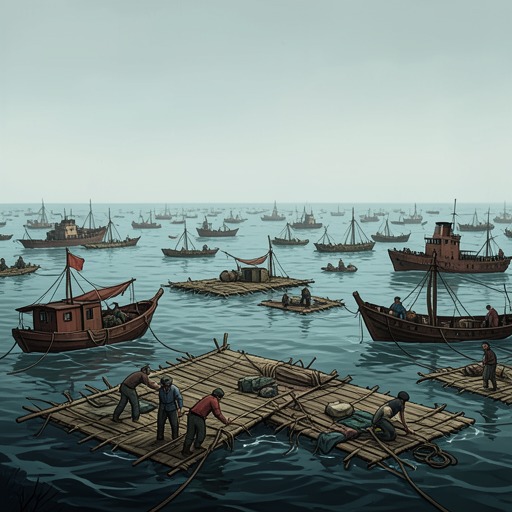
World War ZAlang is a ship-breaking yard on the Indian coast whose meaning changes completely during the Zombie War. Before the crisis, it dismantled the world’s vessels; during the flight from the undead, desperate civilians mistake it for a place where ships might be found and escape might still be possible. The resulting shoreline becomes a concentrated image of the war’s wider catastrophe: industrial remains, desperate migration, predatory exclusion, underwater danger, and acts of rescue all occupy the same narrow strip of sand.
Definition and Prewar Function
Alang is introduced as a long coastal expanse near Bhavnagar, India, surrounded by the rusting wrecks of once-proud ships. The narrator stands there with Ajay Shah and sees abandoned hulls as silent memorials to the carnage that took place on the beach. The government lacks the money to remove them, while time and the elements have rendered their steel largely useless, so the industrial landscape remains in place as both debris and evidence.
Before the war, Alang was the largest ship-breaking yard in the world. Ships from many nations were purchased by Indian scrap-iron companies, driven onto the shore, stripped, cut apart, and disassembled until not even the smallest bolt remained. The vessels visible during the crisis are therefore not functioning transports waiting to carry civilians away. They are naked hulks lined up to die, an industrial image that becomes grimly appropriate once the shoreline itself fills with human beings seeking to escape death.
The Failed Promise of Escape
The narrator, an office manager from nearby Bhavnagar and a white-collar professional who had rarely worked with his hands, does not know Alang’s true nature when he heads there. He knows only that it is a shipyard and expects to find a construction site producing hull after hull for evacuation. Instead, he discovers that Alang kills ships rather than builds them. This mistaken expectation turns a familiar modern idea—the port as a gateway to safety—into a fatal misunderstanding.
There are no dry docks or slipways. Standard procedure is simply to ram ships onto the beach, leaving them stranded like beached whales. The narrator’s remaining hope rests on several newer vessels still anchored offshore, each with a skeleton crew and perhaps some fuel left in its bunkers. One of them, the Veronique Delmas, attempts to pull the partially gutted APL Tulip back into the sea. Ropes and chains are lashed hurriedly to the Singapore container ship’s stern, but the Tulip’s keel has already been badly fractured by beaching. When the Delmas pulls, the stronger chains outlast the weakened hull: the Tulip splits in two, with its bow remaining on shore while its stern is dragged into deep water.
The stern overturns and sinks within seconds, carrying at least a thousand people who have packed the cabins, passageways, and every available section of open deck. Their cries are muffled by the thunder of escaping air. The attempted rescue therefore becomes another mass death, showing that even a vessel capable of movement cannot simply restore an evacuation system after the social and physical infrastructure supporting it has collapsed.
Refugees, Predation, and the Undead Below
Alang is not an isolated maritime disaster. Across the world, people attempt to board anything that floats, and the yard becomes one of many places where the boundary between land and sea offers no reliable protection. Some crews demand money, food, or other valuables before accepting passengers. Others select only young women or light-skinned refugees; one captain rejects people from India’s scheduled castes while waving a gun and shouting his exclusion. The queue for survival reproduces old systems of caste, racism, gendered exploitation, and wealth even as the undead threaten everyone.
Yet the evidence also resists reducing Alang to a scene of universal depravity. For every profiteer or psychopath, the narrator says, many fishermen and small-boat owners continue returning to shore even when they could have escaped with their families. They risk murder for their boats, abandonment on the beach, and attacks from below. Their repeated journeys make rescue a deliberate choice rather than a fortunate accident, and place ordinary maritime workers in opposition to the captains who convert passage into a commodity.
The water itself has become occupied territory. Infected refugees swim toward the ships, drown, and reanimate beneath the surface. Because the tide is low, the water is deep enough to kill a swimmer but shallow enough for a standing undead figure to reach upward for prey. Swimmers vanish without warning, boats capsize as passengers are pulled under, and the sea ceases to function as an escape route. It becomes a submerged extension of the land-based swarm, turning every attempt at rescue into a confrontation with an enemy that can remain unseen until the moment of attack.
Rescue and Narrative Significance
The narrator survives by swimming toward a ship, though the distance proves greater than it appears. After walking from Bhavnagar, fighting for most of the day, and reaching the water with barely enough strength to float on his back, he arrives at the smooth steel side of the intended vessel without a gangway. He has no breath left to call for help and strikes the hull as he begins to sink.
A powerful arm catches him. Expecting teeth, he is instead pulled back to the surface and brought aboard the Sir Wilfred Grenfell, an ex-Canadian Coast Guard cutter. He tries to explain that he has no money and offers to work for his passage, but the crewman asks only that he hold on because the ship is about to get under way. The deck vibrates and then lurches as the cutter moves, converting the narrator’s presumed death into an immediate, undeserved reprieve.
Alang’s decisive significance lies in this collision of systems. It is a place built around dismantling global transport, yet it becomes a desperate gathering point for people who need transport more than ever. The wrecked ships register the long material history of international commerce, while the refugees reveal the human cost of its collapse. The beach also shows that survival cannot be explained by technology or individual strength alone: the narrator is a strong swimmer, but exhaustion nearly kills him, and his life depends finally on a crewman willing to reach down and pull him aboard. In Alang, the war’s most destructive forces—industrial ruin, unequal access, mass flight, and the reanimated dead—are set against the stubborn persistence of rescue.